Getting Started
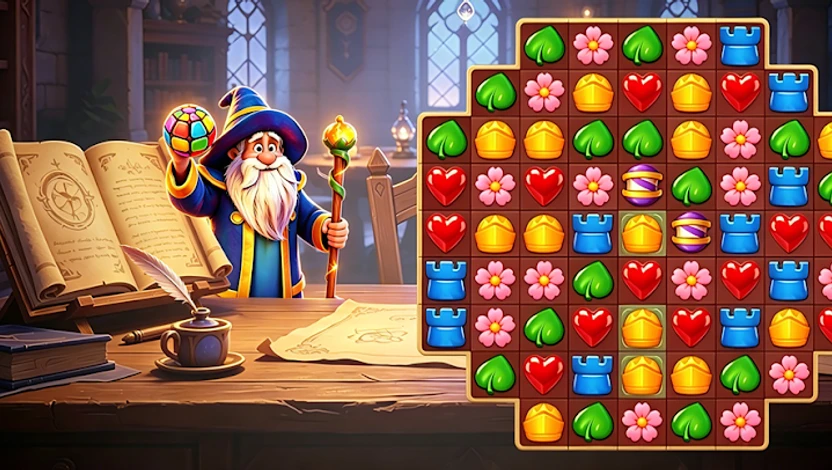
Royal Matcher Puzzle is a crown-themed match-3 game where you swap adjacent gems to form lines of three or more identical tiles. Matches disappear, the tiles above fall down, and new tiles drop in from the top — setting up the potential for chain reactions. The goal varies per level: clear a target number of specific gems, reach a score threshold, or remove obstacles like locked tiles and ice layers.
Swap by clicking one gem and then an adjacent gem (or by dragging one gem onto its neighbor). Only swaps that create a valid match of three or more are allowed — invalid swaps bounce back and waste no moves on most levels, though they do consume a fraction of a second on time-limited stages.
Match-3 Basics
- Matches of three in a row clear normally and award base points.
- Matches of four in a line create a directed power-up gem that clears an entire row or column when matched again.
- Matches of four in a square (2×2) create a bomb that explodes a 3×3 area.
- Matches of five in a line create a color bomb — a wild gem that clears every tile of a chosen color when swapped with one of that color.
- Matches of L or T shapes (five tiles total) also produce bombs.
Learning to recognize these shapes on the board — especially the four-in-a-row and five-in-a-row setups — is the single biggest jump in skill a new player can make.
Always look at the bottom of the board first. Falling tiles create new matches automatically, so working near the bottom gives you the most "free" chain reactions and preserves your move budget.
Chain Reaction Mechanics
When a match clears, the tiles above it fall into the empty space, and new tiles drop from the top. If those falling tiles form a new match, that match also clears — and the cycle continues. Each successive match in a chain multiplies the points awarded, so a single swap that triggers three chain reactions can easily outscore five separate swaps.
Chain reactions are the engine of high scores in Royal Matcher. A skilled player will routinely pass on an obvious match-3 if it disrupts a potential chain, instead setting up a more lucrative sequence one or two moves ahead.
- Identify "loaded" columns. A column with two or three same-color gems stacked with one gap is a chain waiting to fire. Save it for when you need a big score push.
- Trigger from below. A match near the bottom of the board shifts more tiles than one near the top, so it has a higher chance of producing chains.
- Avoid clearing the top of a loaded column. If you remove the topmost gem of a near-match, you break the chain you were trying to set up.
- Read two swaps ahead. Before committing, predict what falls into the gap your match creates. If the new tiles don't form a match, the chain ends immediately.
Power-Up Combo Strategy
Power-ups become far more powerful when combined. Swap any two power-ups together for a combined effect:
- Line + Line: clears both the full row and the full column of the swap, creating a giant plus-shaped clear.
- Line + Bomb: clears three full rows and three full columns — devastating on obstacle-heavy boards.
- Bomb + Bomb: a 5×5 explosion centered on the swap, great for opening up crowded centers.
- Color Bomb + Line: turns every gem of the line's color into a line clearer, effectively clearing most of the board.
- Color Bomb + Color Bomb: the strongest combo in the game — clears the entire board. Save this for emergency clears or final-move score bursts.
If a level gives you two color bombs close together, resist the urge to fire one immediately. Save them both, then swap them with each other for a full-board clear — it's often worth more points than firing them separately.
Time-Limited vs Move-Limited Levels
Time-Limited Levels
- Speed matters more than optimization. Make any valid match quickly rather than hunting for the perfect swap.
- Invalid swaps cost real time on the clock — only attempt swaps you're confident in.
- Chain reactions buy you free time on some levels because the clock pauses during cascades. Trigger them whenever possible.
- Save power-ups for the final 10 seconds, where a single combo can swing a borderline pass into a comfortable win.
Move-Limited Levels
- Every move must count. Optimize for maximum clears per swap, not maximum speed.
- Prioritize the level's actual objective (clear X ice blocks, collect Y red gems) over raw score — chasing score on a move-limited level often causes you to run out of moves before the objective is met.
- Plan a swap two moves ahead, especially when setting up four-in-a-row or five-in-a-row patterns.
- Power-up combos are worth saving — they effectively compress several moves of clearing into one swap.
Scoring System Explained
Royal Matcher awards points in a transparent way once you know the rules:
- Base match-3: ~60 points per gem cleared.
- Match-4: higher base plus the spawned power-up.
- Match-5 / L / T: highest base plus a bomb or color bomb.
- Chain multiplier: each link in a chain multiplies the points earned by that link. A three-deep chain can award 4–5× the base score.
- Power-up combo: awards a flat bonus on top of the cleared tiles, scaling with combo rarity (color bomb + color bomb is the largest).
- Remaining moves bonus: on move-limited levels, every unused move at the end converts into points — typically through automatic power-up activations.
This explains why chain-heavy play beats swap-heavy play: a single chain-3 swap can outscore 8–10 isolated matches. Once you internalize the multiplier, your average score per level will jump sharply.
Common Mistakes
- Matching the first valid swap you see. On move-limited levels this is fine; on score-based levels it leaves huge chain potential on the table.
- Firing power-ups the moment they appear. Power-ups gain 3–5× value when combined with another power-up. Hold them unless the level is about to end.
- Ignoring the objective. Score means nothing if you don't clear the ice blocks in time. Always read the goal before playing.
- Breaking your own loaded columns. Clearing the top of a stacked column wastes the chain. Protect setups you've built.
- Forgetting diagonal L and T shapes. These are easy to miss visually but produce bombs as strong as four-in-a-square matches.
Match-3 mastery is mostly pattern recognition — the more boards you play, the faster you'll spot four-in-a-rows, L-shapes, and chain setups. Combine that eye with disciplined power-up saving, and your average score per level will rise sharply within a single session.