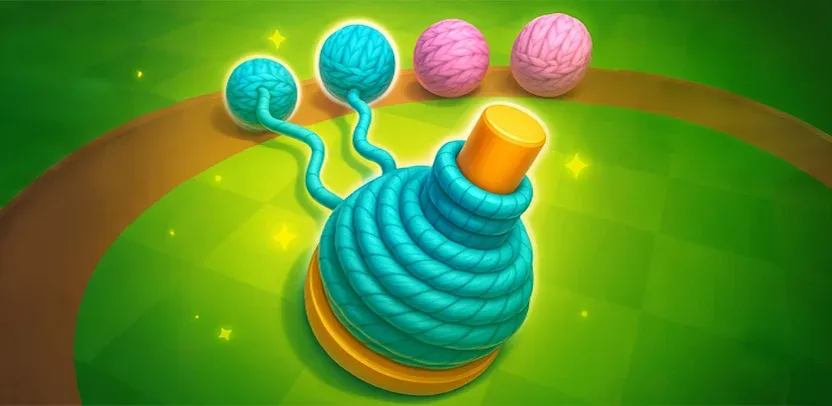
Getting Started
Puzzle: Yarn Fun is an untangling puzzle where each level shows several colored yarn strands laid out across a board. Strands start tangled — crossing each other in messy overlaps — and your job is to drag their endpoints along the board's anchor points until no two strands cross. A level is solved when every strand lies flat without intersecting any other strand. The fewer moves you use, the higher your star rating.
To play, drag an endpoint from its current anchor to an adjacent empty anchor. The strand reroutes automatically along the new path. The browser version on Suntongames is free, runs on desktop and mobile, and requires no sign-up.
Core Mechanics
- Endpoints: every strand has two endpoints. Drag either to reroute the strand.
- Anchors: fixed points on the board where endpoints can sit. You can only move an endpoint to an adjacent free anchor.
- Strand path: the route a strand takes between its two endpoints. The game auto-routes the strand through the shortest valid path given the endpoints' positions.
- Crossing: when two strand paths intersect. The game highlights crossings in red — solve all of them to clear the level.
- Move counter: every endpoint drag counts as one move. Star ratings are based on total moves used versus the par for the level.
Red crossings are your to-do list. Always solve the outermost crossing first — inner crossings often resolve themselves once the outer strand is moved out of the way.
The No-Crossing Principle
Yarn Fun is fundamentally a planarity puzzle: a graph of strands is solvable if and only if it can be drawn on a flat plane without any two edges crossing. The mathematical fact behind this is that any planar graph has at least one valid flat embedding, which means every level in Yarn Fun is solvable — there are no impossible configurations, only tangled ones.
The practical consequence: if you find yourself "almost there" with one stubborn crossing, the fix is rarely local. Move one of the strands involved to a completely different region of the board, then re-route. Local adjustments tend to just shift the crossing rather than eliminate it.
Outer-Loop Priority Strategy
The single most important strategic rule in Yarn Fun is to solve the outer loop first. The outer loop is the strand that, when correctly placed, runs along the perimeter of the board and encloses all the other strands. Once the outer loop is in place, every other strand must live inside it — which dramatically reduces the search space.
- Identify the outer-loop candidate. Look for the strand whose endpoints are closest to the board's edge or corners. That strand is almost always the intended outer loop.
- Drag its endpoints to perimeter anchors. Place both endpoints on or near the board's edge, on the side where the strand naturally wants to wrap.
- Confirm it encloses everything. The outer strand should run around the outside of all other strands. If another strand still pokes outside the loop, you've chosen the wrong outer candidate — try the next-largest strand.
- Solve the next-outermost strand next. Treat the remaining strands as a smaller version of the same problem: find the next outer loop, place it, and recurse inward.
- Finish with the innermost strands. By the time you reach the center, the constraints are so tight that the final strand's path is usually forced.
If you can't tell which strand is the outer loop, count crossings. The strand involved in the most crossings is usually the one that needs to be moved to the perimeter — it's tangled because it's currently in the middle when it should be on the outside.
Three-Star Rating Tips
Star ratings in Yarn Fun are based on move count: one star for clearing the level, two stars for finishing under a moderate par, three stars for finishing at or below the strict par. To consistently three-star levels:
- Plan the entire solve before moving anything. Most three-star pars assume a near-optimal solve. Trial-and-error eats moves fast.
- Move each endpoint at most once. If you find yourself dragging the same endpoint twice, you misjudged its destination — undo and rethink.
- Solve outer to inner, never the reverse. Solving an inner strand first often forces you to move it again when the outer loop is placed.
- Use undo freely while planning. Undo doesn't cost moves on most levels, so use it to test placements without committing.
- Avoid "shifting" a crossing. Moving an endpoint to clear one crossing can create another. Always verify the new configuration is strictly better before committing.
Move-Count Optimization
Beyond the general tips above, a few specific techniques help shave moves off your solves:
- Two-endpoint strands need only one move each. If a strand's correct position only requires one of its endpoints to move, move only that endpoint. Don't reposition both just to be safe.
- Look for "free" solves. Sometimes moving one endpoint to its correct position simultaneously resolves multiple crossings. These multi-solving moves are the backbone of optimal play.
- Don't over-route. A strand doesn't need to take the geometrically shortest path — it needs to take a path that doesn't cross anything. Sometimes a slightly longer route avoids two crossings instead of one.
- Anchor adjacency matters. An endpoint can only move to an adjacent free anchor. Plan multi-step endpoint journeys in advance to avoid wasted intermediate moves.
- Replay for stars after clearing. Once you know the solution, replaying for three stars is much faster than trying to three-star a level blind.
Common Mistakes
- Solving crossings one at a time, locally. Each local fix often creates a new crossing elsewhere. Always think globally.
- Ignoring the outer loop. Trying to solve inner strands first almost always wastes moves later when you have to reposition them.
- Moving both endpoints when one would do. Many strands can be untangled by moving only one endpoint. Always check if the second endpoint really needs to move.
- Forgetting that the game auto-routes. You don't need to specify the strand's path — only the endpoints. Trying to "shape" the path by moving endpoints in odd ways usually wastes moves.
- Refusing to undo. Undo is free. If a move doesn't immediately improve the board, undo it and try a different anchor.
- Chasing stars on a first playthrough. Solve the level once to learn its structure, then replay for stars. Trying to three-star blind is much harder.
Yarn Fun rewards spatial reasoning and patience. Once the outer-to-inner method becomes second nature, even the messiest tangles fall to a handful of well-chosen endpoint moves — and your three-star rate will climb steadily as a result.